


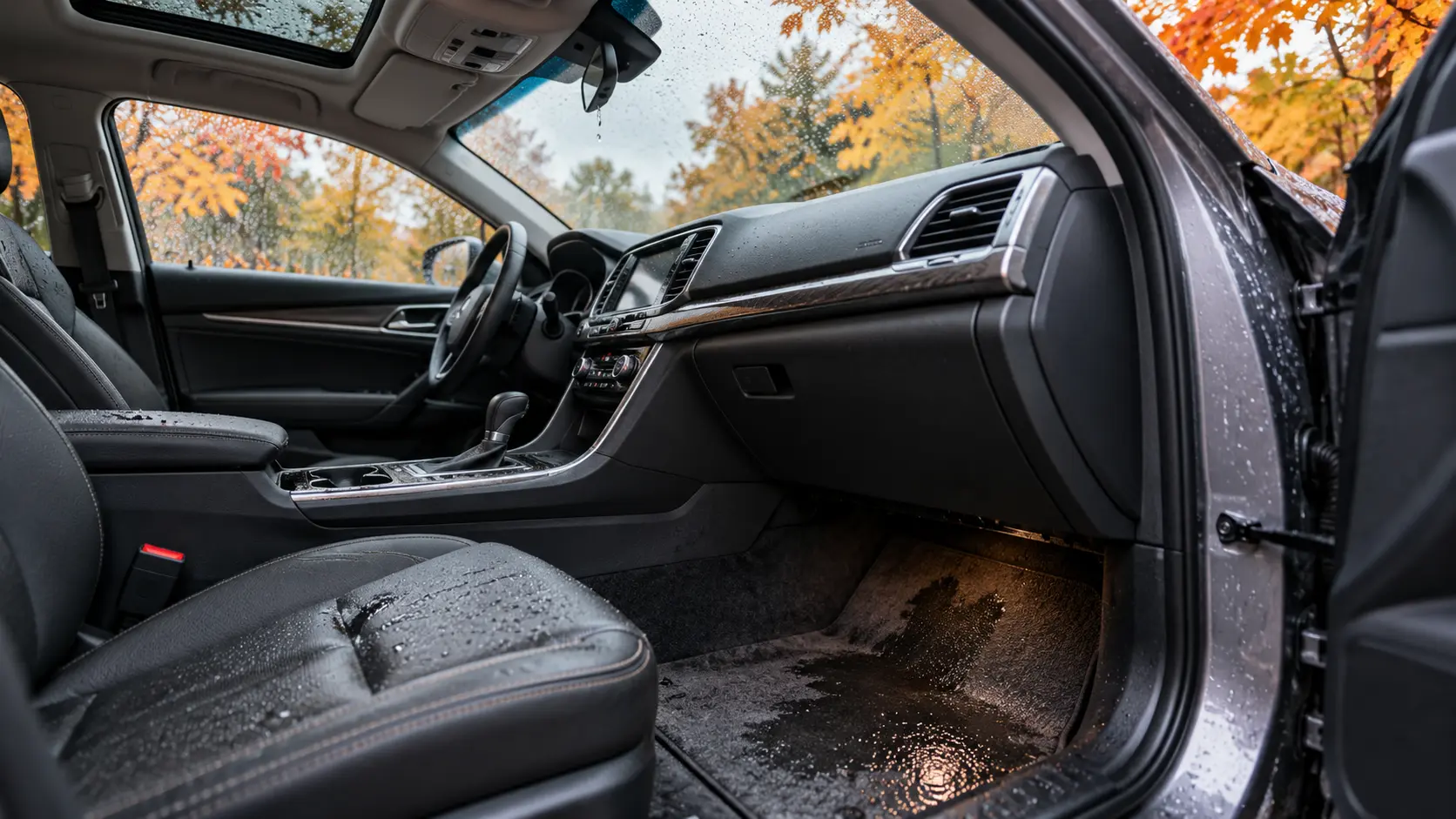
Finding water on the floor of your car can be confusing, especially when there is no obvious open window, damaged door seal, or visible leak. One day the carpet is dry. Then, after a heavy rain or a few days parked beneath trees, you notice a damp passenger-side floorboard or even a small puddle.
In many cases, the source is not a dramatic body leak at all. A clogged sunroof drain, restricted cowl drainage area, or blocked air-conditioning condensate drain can all allow water to end up inside the passenger compartment. The challenge is figuring out which system is responsible.
That distinction matters because these drainage systems perform different jobs. Sunroof drains are designed to carry rainwater away from the sunroof tray. Cowl drains manage exterior water near the base of the windshield. Your air-conditioning system produces condensation that normally exits through a separate evaporator drain beneath the vehicle.
For Madison drivers, October can be an especially good time to pay attention. Falling leaves, seed pods, dirt, pollen, and other organic material tend to collect around drainage areas just as autumn rain becomes more common. A vehicle parked beneath trees day after day can accumulate a surprising amount of debris before anyone realizes a drain is becoming restricted.
Knowing when the water appears, where the interior first becomes damp, and what the vehicle was doing beforehand can help narrow the possibilities considerably.
Why Is There Water on My Car Floor?
The location of the puddle is important, but the timing is often an even better clue.
If the floor becomes wet after a rainstorm or car wash, the water is more likely coming from somewhere outside the vehicle. Sunroof drainage, cowl drainage, weather sealing, or another body drainage path may deserve attention.
If the floor becomes wet on a completely dry day after the air conditioner has been running for an extended period, the A/C evaporator drain becomes a more likely suspect.
A damp headliner, moisture near an A-pillar, or staining around the upper interior can also point technicians toward a different area than water that appears only at the bottom of the passenger footwell.
These clues do not diagnose every vehicle by themselves. Water can travel along trim, wiring, sheet metal, insulation, and carpeting before it becomes visible. The puddle you notice may be several feet from the place where the water first entered.
That is one reason finding the source is more important than simply drying the carpet.
How a Clogged Sunroof Drain Can Put Water on the Floor
Many drivers assume a sunroof is supposed to form a completely watertight seal around the glass. In reality, many sunroof assemblies are designed with channels that collect small amounts of water and direct it into drain tubes.
Those tubes generally route water away from the roof and toward designated exit points lower on the vehicle. The exact design varies by manufacturer and model.
Problems begin when those drainage paths stop flowing properly.
Small leaves, dirt, pollen, seeds, road debris, and accumulated organic material can collect around the sunroof tray and drain openings. A drainage hose can also become restricted, kinked, disconnected, or otherwise unable to move water at the rate intended.
When water cannot drain away, it may rise within the sunroof tray and find another path into the vehicle. Depending on the design, moisture can appear around the headliner, down an A-pillar, near a door opening, or eventually in the carpeting.
This is not just a theoretical possibility. Manufacturer service bulletins published through the National Highway Traffic Safety Administration have documented vehicles experiencing interior water leakage because sunroof drain components became clogged with foreign material. One such manufacturer sunroof drain service bulletin describes interior water leakage associated with obstructed sunroof drain hose plugs. The repair procedures in that bulletin are vehicle-specific, but the underlying lesson is useful: sunroof drainage problems can absolutely allow water into a passenger compartment.
Why Fall Leaves Can Make Drainage Problems More Noticeable
Autumn in Madison creates a nearly perfect environment for drainage problems to become visible.
A car may spend weeks parked beneath mature trees while leaves, seed material, dirt, and other debris accumulate around the windshield, sunroof opening, roof channels, and body drainage areas. Add several rainy days, and water suddenly has to move through drainage paths that may already be partially restricted.
Large leaves are easy to see and remove. Smaller material is often the bigger problem because it can work its way into narrow openings or combine with dirt to create buildup that is harder to notice from above.
This does not mean every car parked beneath a tree will develop a leak. It does mean that autumn provides a useful reminder to keep exterior drainage areas reasonably clean and to investigate new interior moisture instead of waiting for it to disappear.
Madison’s changing fall weather can make these symptoms seem inconsistent. A car may stay dry during a light rain but develop water inside during a heavier storm because a partially obstructed drain simply cannot move water quickly enough.
Could the Water Be Coming From the Cowl?
The cowl is the area around the base of the windshield, usually beneath or near the windshield wipers. It is another place where leaves and debris commonly accumulate.
Vehicle manufacturers design this area to manage rainwater and move it away from places where it could enter the cabin. Depending on the vehicle, the cowl area can also be near the HVAC fresh-air intake and other openings that need to remain properly protected from water.
If exterior drainage passages become restricted, water may pool or travel somewhere it normally would not. In some vehicles, that can eventually contribute to moisture in a front footwell.
A cowl-related leak may look very similar to another water leak from inside the cabin. That is why technicians pay attention to what happened immediately before the floor became wet.
If water appears following rain while the vehicle has simply been parked, an exterior drainage or sealing problem becomes more likely. If the same area becomes wet after running the air conditioner on a sunny day, the diagnostic direction changes.
Could the A/C Drain Be Causing the Wet Floor?
Air conditioning does more than cool the cabin. It also removes moisture from the air.
As humid air passes across the cold evaporator inside the HVAC system, water condenses on the evaporator. Under normal conditions, that condensation drains through a tube and exits underneath the vehicle. Seeing water dripping beneath a parked vehicle while the A/C has been running can therefore be completely normal.
The problem comes when the evaporator drain becomes restricted.
Instead of leaving the vehicle, condensation may collect inside the HVAC housing and eventually find its way into the passenger compartment. Depending on the vehicle’s layout, the passenger-side floor is a common place to notice the result.
The timing provides an important clue. If it has not rained for days but the floor becomes wet after a long drive with the air conditioner running, the evaporator drain deserves attention.
This is different from leaves blocking a sunroof or cowl drainage opening. The A/C condensate drain is a separate system carrying moisture produced by the HVAC system itself.
Capitol Tire & Service’s ASE-certified technicians handle complete HVAC diagnostics, including evaporator and other air-conditioning system concerns. If the moisture appears connected to A/C operation, professional car A/C repair and diagnostics can help determine whether condensation is draining correctly or whether another HVAC issue is involved. Capitol has served Madison drivers since 1985 and provides diagnostic and repair services for both traditional R-134a and newer R-1234yf systems.
How Can You Tell Which Drain Is Causing the Problem?
One of the best diagnostic tools is surprisingly simple: think about what was happening before the water appeared.
Water after a rainstorm or car wash points technicians toward exterior water management first. That can include the sunroof, cowl area, body seals, and other drainage paths.
Moisture that develops after prolonged A/C operation during dry weather makes condensation drainage more suspicious.
A damp headliner or moisture beginning high on an A-pillar can strengthen the case for investigating the sunroof drainage system. A front footwell that becomes wet after rainfall may shift attention toward cowl or body drainage areas.
Another useful clue is repetition. If water appears every time the car sits outside during rain but never after the A/C runs, that pattern matters. If the carpet stays dry through several storms but becomes wet after every long summer drive with the air conditioner on, that pattern matters too.
Technicians also look beyond the puddle itself. Water follows gravity, but it can also follow seams, trim panels, wiring harnesses, insulation, and structural channels. The wettest visible spot is not always the entry point.
A professional water-leak diagnosis is therefore partly detective work. The objective is not simply to prove that the carpet is wet. It is to reproduce or trace the condition carefully enough to identify where the water is coming from.
Why Drying the Carpet Does Not Solve the Leak
Removing visible water is useful, but it does not address why the water entered.
Automotive carpeting can also hide considerably more moisture than the surface suggests. Padding, insulation, and sound-deadening materials underneath may remain wet even when the top of the carpet begins to feel dry.
If moisture continues returning, the cabin can develop unpleasant odors, staining, or mildew. Prolonged exposure can also become more concerning when electrical connectors, wiring, modules, or other components are located beneath or around the affected area.
That does not mean a wet floor automatically leads to an expensive electrical problem. It means repeated water intrusion should be corrected before moisture has the opportunity to create additional issues.
Electrical diagnostics are among the services Capitol Tire & Service provides, and the shop’s technicians work across engine, ignition, electrical, heating, cooling, and other systems. That broader diagnostic capability can matter when an interior water problem has been present long enough to affect more than the carpet.
Can You Clear a Clogged Sunroof Drain Yourself?
There are some useful things vehicle owners can do without taking the car apart.
Visible leaves and loose debris around a sunroof opening or at the base of the windshield can often be removed carefully before they build up further. Keeping those areas clean is especially worthwhile when a vehicle spends most of autumn parked outdoors.
Where DIY work becomes more questionable is when someone tries to force a blockage through a drain hose without knowing how that particular vehicle is constructed.
Aggressively pushing stiff wire through a tube or blasting high-pressure compressed air into a drainage system can create a different problem if a hose is damaged, separated from a fitting, or pushed somewhere it does not belong. Drain routing and connections vary widely among vehicles.
If the carpet is already wet, water keeps returning, or the source is unclear, identifying the actual failure is usually more valuable than attempting to clear whichever opening looks easiest to reach.
What Should You Avoid Doing With a Suspected Drainage Problem?
Avoid assuming that every wet passenger floor is a clogged sunroof drain.
A wet floor is a symptom. The correct repair depends on the cause.
Avoid repeatedly drying the interior without checking why it became wet. If the moisture returns, the vehicle is giving you useful diagnostic information.
It is also wise to avoid pouring large amounts of water into suspected drainage channels without knowing where those channels are supposed to exit. Controlled water testing can be an effective diagnostic technique in professional hands, but randomly flooding areas of the vehicle can make it harder to determine the original source.
Most importantly, do not assume that a disappearing puddle means the underlying problem fixed itself. Water may evaporate. Leaves may shift temporarily. A partially restricted drain may handle light rain and then overflow during the next heavy storm.
Patterns matter.
How Long Does This Kind of Repair Take?
There is no honest universal answer because the visible symptom does not tell you how difficult the source will be to reach.
A straightforward obstruction in an accessible drainage point may be relatively simple to address. A leak that requires trim removal, drain-hose inspection, repeated water testing, or carpet removal can take considerably more diagnostic time.
The make and model also matter. Drain locations and interior construction differ, and the same symptom can require different procedures on different vehicles.
If water has soaked deeply into the carpet or padding, drying the affected materials may also become part of the job.
For that reason, repair time depends less on the size of the puddle than on how quickly the source can be positively identified. A small amount of water can come from a tricky leak. A surprisingly large puddle can sometimes trace back to a relatively simple obstruction.
The professional approach is to diagnose first and estimate from what is actually found rather than using the appearance of the carpet to predict the repair.
Technician Tips for Tracking Down Interior Water
Pay attention to the weather and vehicle use before cleaning everything up. Knowing whether the water appeared after rain, a car wash, or an extended period of A/C operation can save significant diagnostic time.
Notice where the moisture begins rather than only where it eventually collects. Dampness around the roof, upper pillar trim, or headliner tells a different story from moisture that appears only at the bottom of the passenger footwell.
Smell can provide another clue. If the carpet surface seems dry but a musty odor remains, moisture may still be trapped in the padding beneath it.
Finally, repeat symptoms matter more than one isolated observation. Water that appears under the same circumstances again and again gives a technician a pattern to follow. That pattern is often much more useful than guessing from the puddle alone.
How Seasonal Maintenance Can Help Prevent Water Intrusion
Prevention starts with paying attention to areas that collect debris.
During Wisconsin fall, that means occasionally clearing loose material from around the windshield and sunroof opening and looking for obvious buildup before it becomes packed into smaller drainage paths.
Seasonal inspections also provide an opportunity to catch unrelated problems before winter. Capitol’s preventive auto maintenance includes checks of HVAC operation, electrical systems, belts, hoses, filters, tires, steering, suspension, and other systems based on the vehicle’s make, model, mileage, and use.
That kind of broader approach is useful because an interior water problem does not always exist in isolation. A clogged drain may be the immediate concern, but fall is also when Madison drivers begin relying more heavily on defrosting systems, heaters, tires, batteries, and other cold-weather equipment.
Capitol Tire & Service is an ASE-certified shop and NAPA Auto Care Center, and owner Bert Fuller is an ASE Certified Master Technician with advanced engine performance credentials. Those qualifications matter most when they translate into careful diagnosis rather than assumptions about where the water must be coming from.
Frequently Asked Questions About Water on the Car Floor
Can a clogged sunroof drain really cause water on the floor? Yes. Many sunroof systems collect rainwater in channels and route it through dedicated drains. If the drainage system becomes obstructed or damaged, water can overflow and travel through interior areas before reaching the carpet. The exact path depends on the vehicle.
Why is my passenger-side floor wet when it has not rained? If the floor becomes wet after extended A/C use during dry weather, an obstructed evaporator condensate drain is one possibility. A technician should still confirm the source because other leaks can appear in the same general area.
Why does my car leak only during heavy rain? A drainage path can be partially restricted rather than completely blocked. It may handle a small amount of water but become overwhelmed during heavier rainfall. Sealing issues can also become more noticeable when a larger volume of water is present.
Can leaves clog the drains in my car? Leaves and smaller organic debris can collect around sunroof and cowl drainage areas, particularly on vehicles that spend substantial time parked beneath trees. Smaller material such as pollen, seeds, and dirt can contribute to buildup as well.
Should I try compressed air to clear a sunroof drain? Use caution. Drain hoses, fittings, and routing differ by vehicle, and excessive pressure may create additional problems if a hose or connection is disturbed. When a drain is not easily cleared or water has already entered the cabin, professional diagnosis is the safer approach.
Is water on the floor an emergency? Not necessarily, but it should not be ignored if it keeps returning. Persistent moisture can lead to odor and mildew and may eventually affect nearby electrical components. Finding the cause early is generally easier than repeatedly dealing with a wet interior.
Get the Source of the Leak Checked Before the Next Rain
A puddle on your car floor does not automatically mean you have a major repair ahead of you. Sometimes the cause is a relatively simple drainage restriction. The important part is identifying whether the water is coming from the sunroof drainage system, cowl area, A/C evaporator drain, or another source before guessing at the fix.
Capitol Tire & Service has been serving Madison drivers since 1985 from 5610 Odana Road. Our ASE-certified team handles automotive diagnostics, HVAC service, electrical concerns, preventive maintenance, and general repair, giving us several ways to investigate a water problem when the source is not immediately obvious.
If you have discovered wet carpeting, unexplained moisture, or a puddle that keeps returning, you can contact Capitol Tire & Service or call (608) 271-9009. Catching the source before the next heavy rain is a lot more useful than owning the world’s most absorbent collection of shop towels.

Meet Bert, Capitol Tire and Service’s owner! With over 30 years in the automotive repair industry, his commitment to excellence has earned him an ASE Certification as a Certified Master Technician with a L1 (Advanced Engine Performance Specialist). In addition, he is Master ASE Engine Machinist Certified and ASE Under Car Specialist. He is a graduate of MATC auto tech program with an Associate Degree in Applied Science. He enjoys the daily challenge that the automobile delivers and the satisfaction of keeping them going. Bert likes to spend his weekends with his wife, Kelli, two daughters and his best buddy, Scout. They enjoy outdoor family activities such as: camping, boating, fishing and snowmobiling.