
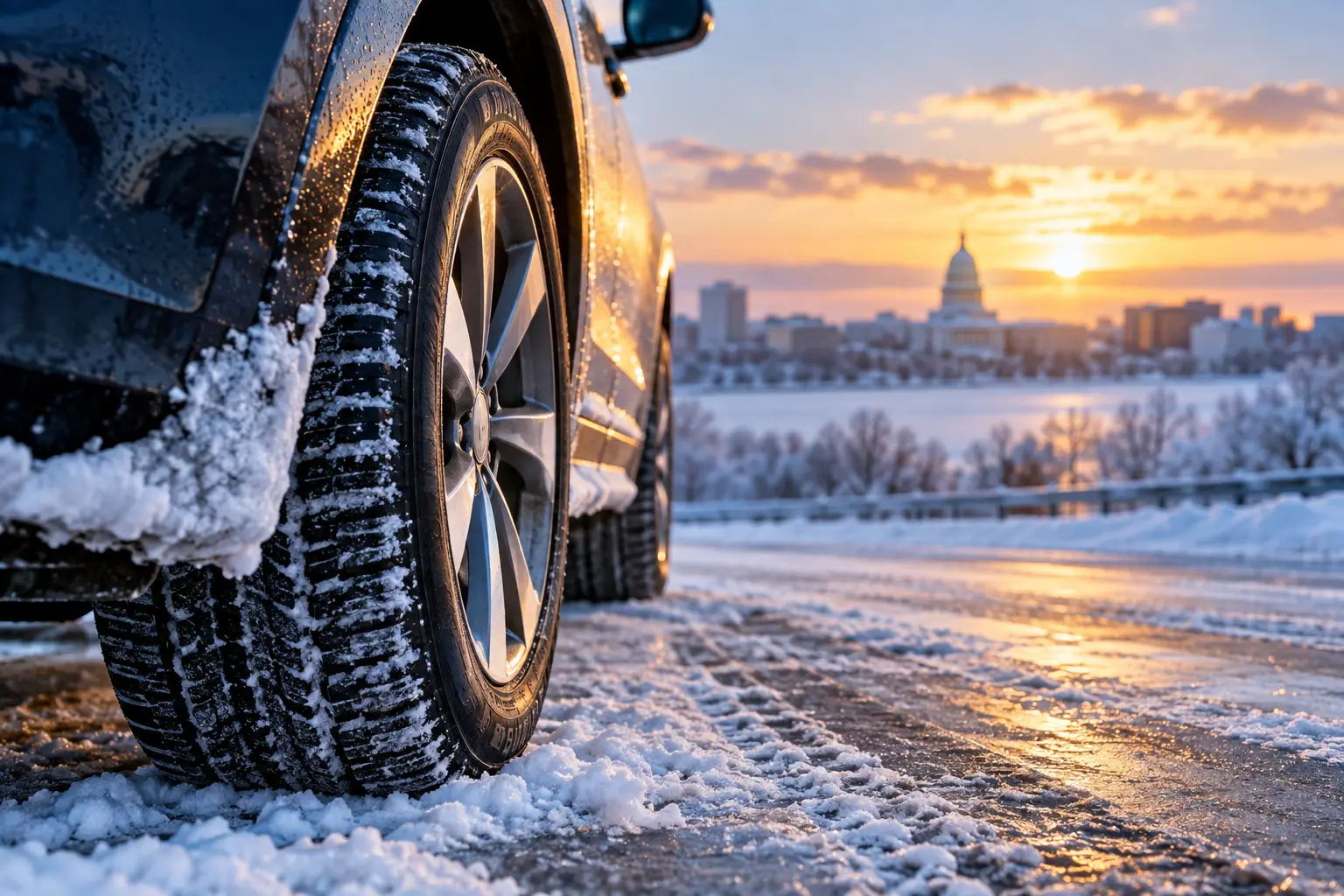
The first genuinely cold morning in Madison has a way of getting your attention. You start the car, reach for the heat, and suddenly the tire pressure warning light is glowing on the dashboard.
It is one of the most common cold-weather surprises drivers experience, and it does not automatically mean you picked up a nail overnight. As outside temperatures fall, tire pressure falls with them. A tire that was already near the lower end of its proper pressure range during a warm afternoon can drop enough overnight to trigger the vehicle’s Tire Pressure Monitoring System, or TPMS.
At Capitol Tire & Service, we have been helping Madison-area drivers prepare their vehicles for Wisconsin winters since 1985. That experience has taught us that cold weather tire pressure is not something to think about only after a dashboard light comes on. It is part of getting a vehicle ready for the season.
That is also why, when winter approaches, our technicians may account for the coming temperature drop when setting tire pressures. You may hear us talk about adding roughly 3 to 5 PSI as temperatures head downward. What matters, however, is understanding the vehicle, the manufacturer’s recommended cold inflation pressure, the current tire temperature, and the conditions the vehicle is about to face. It is not a blanket instruction to arbitrarily add pressure to every tire.
Here is what Madison drivers should know before winter settles in.
Why Does Tire Pressure Drop in Cold Weather?
The air inside your tire responds to temperature changes. As the temperature drops, the pressure of that air decreases. That means a tire can have an appropriate pressure during warmer weather and measure noticeably lower after the temperature falls.
This is particularly easy to notice in Wisconsin during fall. We can have a relatively mild afternoon followed by a sharply colder night. The vehicle has not necessarily developed a problem during those few hours. The air inside the tires has simply cooled along with everything else.
That does not mean low pressure should be ignored. Tire pressure is one of the fundamental parts of tire maintenance because it affects how the tire carries the vehicle’s weight, how the tread meets the pavement, how the vehicle handles, and how the tire wears.
The National Highway Traffic Safety Administration recommends checking tires when they are cold and using the vehicle manufacturer’s recommended inflation pressure, which can normally be found on the driver-side door placard or in the owner’s manual. NHTSA also makes an important distinction that is easy to miss: the pressure molded into the tire sidewall is a maximum tire specification, not the recommended inflation pressure for your particular vehicle.
What Does “Cold Tire Pressure” Actually Mean?
In tire talk, a “cold” tire is one that has not built up heat from driving, whatever the season. NHTSA defines a cold tire for pressure-checking purposes as one that has not been driven for at least three hours.
That distinction matters because tires heat up as you drive. As the tire and the air inside it become warmer, the measured pressure can increase. If you check pressure immediately after a long drive, you may get a different number than you would have seen before leaving home that morning.
That is one reason professional tire-pressure checks involve more than glancing at a number on a gauge. A technician considers when the vehicle was driven, the pressure recommended by the vehicle manufacturer, the readings from all four tires, and whether one tire is behaving differently from the others.
For Madison drivers, this becomes especially important during the transition from fall into winter because large temperature swings can produce noticeably different readings within a relatively short period.
Why Does the TPMS Light Come On After a Cold Night?
Your TPMS is designed to warn you when tire pressure has fallen significantly below an acceptable level. It does not know that Wisconsin had a cold front overnight. It simply recognizes the pressure condition it was designed to monitor.
That is why the warning often seems to appear out of nowhere on a cold morning.
NHTSA specifically notes that a TPMS warning can illuminate during a cold morning when marginally low pressure falls below the system’s warning threshold and may later disappear as the tire or outside temperature becomes warmer. Even if the warning goes away, the agency recommends checking the tire pressure rather than assuming everything is fine.
The key word is “checking.”
If all four tires have changed in a similar way after a major temperature drop, temperature may be a significant part of what you are seeing. If one tire is substantially lower than the others, or the same tire repeatedly loses pressure after being corrected, that deserves a closer look.
A cold morning can reveal low pressure. It should not become an excuse to dismiss it.
Why Capitol Tire & Service Adjusts Tire Pressure Before Wisconsin Winter
After decades of working on vehicles in Madison, we know that the pressure you see during mild fall weather may not be the pressure you see after sustained winter temperatures arrive.
That is why Capitol Tire & Service takes upcoming temperature changes into account when preparing tires for winter. When we refer to adding approximately 3 to 5 PSI heading into colder weather, we are talking about a technician making a seasonal adjustment based on the tire’s present condition, the vehicle’s specification, the temperature at the time of service, and the colder conditions ahead.
It should not be interpreted as a universal instruction to take the pressure printed on your door placard and automatically add five pounds to it.
The proper approach starts with the vehicle manufacturer’s specification and an accurate reading. From there, a knowledgeable technician can account for the conditions under which the tire is being measured and the temperatures the vehicle is likely to encounter.
That difference is important. Good tire service starts with understanding what the reading means.
Capitol Tire & Service is an ASE-certified shop, a NAPA Auto Care Center, and a Bridgestone/Firestone affiliated dealer. Tire work has been a core part of the business since Capitol opened in Madison in 1985. When you need more than a pressure adjustment, our tire repair and alignment services are designed to help identify tire wear, repair needs, alignment concerns, and other issues that may be affecting how the vehicle drives.
Does a Cold-Weather TPMS Light Mean You Have a Leak?
Not necessarily, but this is where paying attention to the pattern helps.
A general pressure decrease across several tires after a major temperature change is different from one tire that repeatedly ends up lower than the others.
If one tire continues losing pressure after being corrected, possibilities can include a puncture, a valve-related issue, a leak where the tire seals against the wheel, wheel damage, or another tire problem that needs inspection.
This is one reason we do not like the idea of simply adding air over and over without finding out why it keeps disappearing.
An occasional adjustment because temperatures have changed is one thing. A tire that repeatedly needs air is telling you something.
A useful technician’s rule of thumb is to compare the tires rather than looking at only the one that triggered your attention. If three tires remain relatively consistent and one is repeatedly low, temperature alone becomes a less satisfying explanation. That tire deserves to be inspected.
Should You Just Add Air at the Gas Station?
You certainly can check and adjust tire pressure yourself. In fact, knowing how to use an accurate tire gauge is a useful skill for any driver.
The important part is doing it correctly.
Start with the vehicle manufacturer’s recommended pressure rather than the maximum pressure printed on the tire. Whenever possible, check the tires when they are cold. Measure all four tires, not simply the one you suspect is low, and pay attention to meaningful differences between them.
What a professional tire check adds is context.
A technician can compare all four pressures, look at the tread and sidewalls, identify unusual wear patterns, check for evidence of a slow leak, and consider whether the pressure problem may be connected to another tire or suspension issue.
This is particularly useful if you are repeatedly adding air, the TPMS light keeps returning, one tire is consistently lower than the rest, or the vehicle does not feel quite right on the road.
A gas-station air compressor works fine for topping off. If you find yourself using it often, the real question is why the tire keeps getting low in the first place.
Why Proper Tire Pressure Matters During a Wisconsin Winter
A tire is the vehicle’s connection to the road, and its inflation pressure affects the way it maintains that contact.
When pressure is too low, the tire does not maintain its intended shape and operating characteristics. That can affect handling and accelerate unwanted wear. Proper inflation also matters for tire durability and fuel consumption.
Those concerns matter year-round, but Wisconsin winter adds another layer. Snow, ice, slush, cold pavement and changing road conditions already ask more of the tire. Starting with properly maintained tires gives them a better opportunity to perform as designed.
Pressure is only one part of that equation. Tread condition, tire age, alignment, suspension condition and the type of tire installed all matter as well.
For example, if a tire is wearing unevenly, repeatedly adjusting the pressure will not correct an alignment problem. If tread depth is insufficient for the conditions, proper pressure cannot restore tread that is no longer there.
That is why winter preparation works best as part of a broader approach to seasonal auto maintenance. Capitol’s maintenance services include tire condition and pressure checks along with other winter-relevant systems, including batteries, heating and defrost systems, fluids, brakes, steering and suspension components.
How Often Should You Check Tire Pressure During Winter?
Tire pressure should not be a “set it in November and forget it until spring” item.
NHTSA recommends inspecting tire pressure at least monthly when the tires are cold. In Wisconsin, it also makes sense to pay attention after a significant change in temperature or whenever the TPMS light appears.
A pressure check is particularly worthwhile when the season changes quickly. A vehicle that was properly set up during relatively mild weather may encounter much colder conditions only a few weeks later.
There is another practical reason to keep checking: not every winter pressure problem is caused by winter.
If a tire repeatedly loses air over several days or weeks, continuing to top it off can hide a slow leak. The sooner the actual cause is identified, the sooner you can determine whether the tire simply needs adjustment, can be repaired, or requires another solution.
The spare tire deserves attention, too, when the vehicle has one. It is easy to forget because you do not see it doing any work until the day you need it.
Frequently Asked Questions About Cold Weather Tire Pressure
Why did my tire-pressure light come on as soon as the weather got cold?
A drop in outside temperature can reduce tire inflation pressure enough to trigger the TPMS warning, particularly if the tire was already near the system’s threshold. You should still check the pressures rather than assume temperature is the only cause.
Will my TPMS light go away when the temperature warms up?
It can. As outside temperatures rise or the tires warm during driving, the measured pressure can increase enough that the warning disappears. That does not necessarily mean the tires were properly inflated in the first place. Check them with an accurate gauge.
Should I automatically add 3 to 5 PSI to my tires for winter?
No. Capitol Tire & Service may make a 3-to-5-PSI seasonal adjustment as part of preparing a particular vehicle for colder conditions, but that should not be treated as universal DIY advice. The starting point is always the vehicle manufacturer’s recommended cold inflation pressure and the conditions under which the tire is being measured.
How can I tell the difference between cold-weather pressure loss and a tire leak?
Patterns help. If several tires change similarly after a sharp temperature drop, weather may be contributing. If one tire continually loses more pressure than the others or needs repeated air adjustments, it should be inspected for a leak or other problem.
Can I keep driving when the TPMS light comes on?
Do not ignore it. Check the tires and their pressures as soon as reasonably possible. A cold-weather pressure change may be the cause, but a warning can also indicate meaningful underinflation or a tire problem that needs attention.
Should I check tire pressure before or after driving?
For the most useful comparison with the vehicle manufacturer’s cold-pressure specification, check the tires before substantial driving or after the vehicle has been parked long enough for the tires to cool. NHTSA recommends at least three hours without driving when checking cold tire pressure.
Start Winter With the Right Tire Pressure
Cold weather tire pressure is one of those small maintenance details that becomes much more noticeable once Wisconsin temperatures start falling. The good news is that it is also one of the easiest things to check.
If your TPMS light appeared after Madison’s latest cold snap, one tire keeps losing air, or you simply want to know whether your tires are ready for winter, Capitol Tire & Service offers free tire-pressure checks. We can check the pressures, compare the tires and help determine whether you are seeing a normal seasonal change or something that deserves a closer look.
Capitol Tire & Service has served Madison drivers since 1985 from 5610 Odana Road. You can contact Capitol Tire & Service to plan a visit, or call (608) 271-9009.
We would rather help you understand what your tires are telling you before a simple pressure concern becomes a bigger winter problem.

Meet Bert, Capitol Tire and Service’s owner! With over 30 years in the automotive repair industry, his commitment to excellence has earned him an ASE Certification as a Certified Master Technician with a L1 (Advanced Engine Performance Specialist). In addition, he is Master ASE Engine Machinist Certified and ASE Under Car Specialist. He is a graduate of MATC auto tech program with an Associate Degree in Applied Science. He enjoys the daily challenge that the automobile delivers and the satisfaction of keeping them going. Bert likes to spend his weekends with his wife, Kelli, two daughters and his best buddy, Scout. They enjoy outdoor family activities such as: camping, boating, fishing and snowmobiling.